
leave a message
If you are interested in our products and want to know more details,please leave a message here,we will reply you as soon as we can.


Luxury Vinyl Tile (LVT) has become one of the fastest-growing flooring categories worldwide, prized for its durability, realistic wood and stone visuals, and ease of installation. But behind the attractive designs lies a tough manufacturing challenge: LVT is a multi-layer composite, and every layer must be uniform in thickness, perfectly bonded, and free of defects — at increasingly demanding output targets.
This is where high-speed LVT flooring extrusion lines change the game. By combining twin-screw extrusion, multi-layer co-extrusion, precision calendering, and automated process control, modern lines deliver a step change in throughput, consistency, and cost per square meter. Here is how they do it.
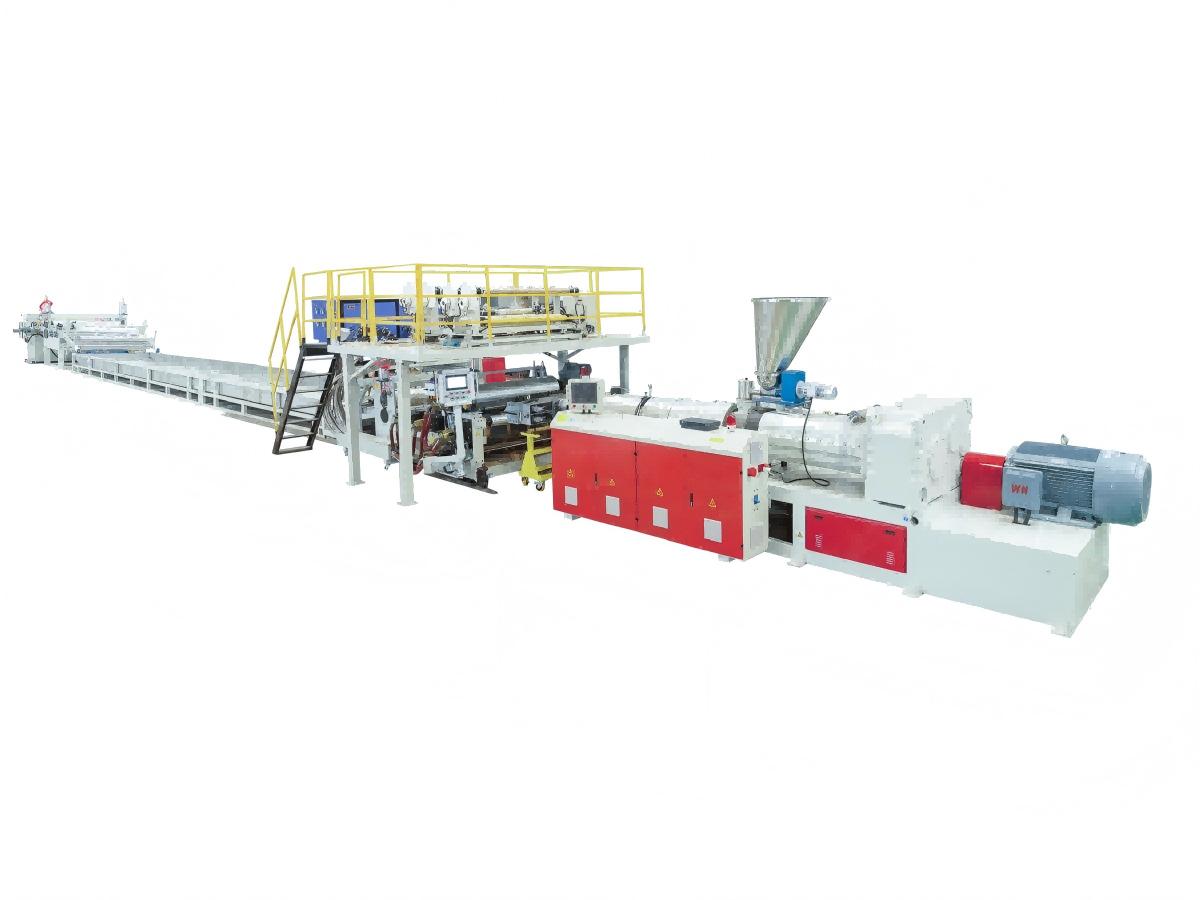
An LVT extrusion line turns PVC resin, calcium carbonate filler, plasticizers, stabilizers, and additives into a finished flooring sheet in one continuous process:
Material mixing → twin-screw extrusion → T-die forming → multi-roll calendering → film & wear-layer lamination → cooling → trimming → cutting → stacking
Whereas older equipment treated each stage as a separate, manually supervised step, a high-speed line integrates them into a single, tightly synchronized flow.
For manufacturers evaluating an integrated solution, explore the LVT Flooring High-speed Extrusion Line from SKY WIN.
1. Twin-Screw High-Speed Extrusion Twin-screw extruders plasticize the PVC compound far more thoroughly and convey it faster than single-screw designs. Better mixing means a more homogeneous melt, stable extrusion at higher speeds, and — with an optimized screw geometry — lower energy consumption per kilogram of output.
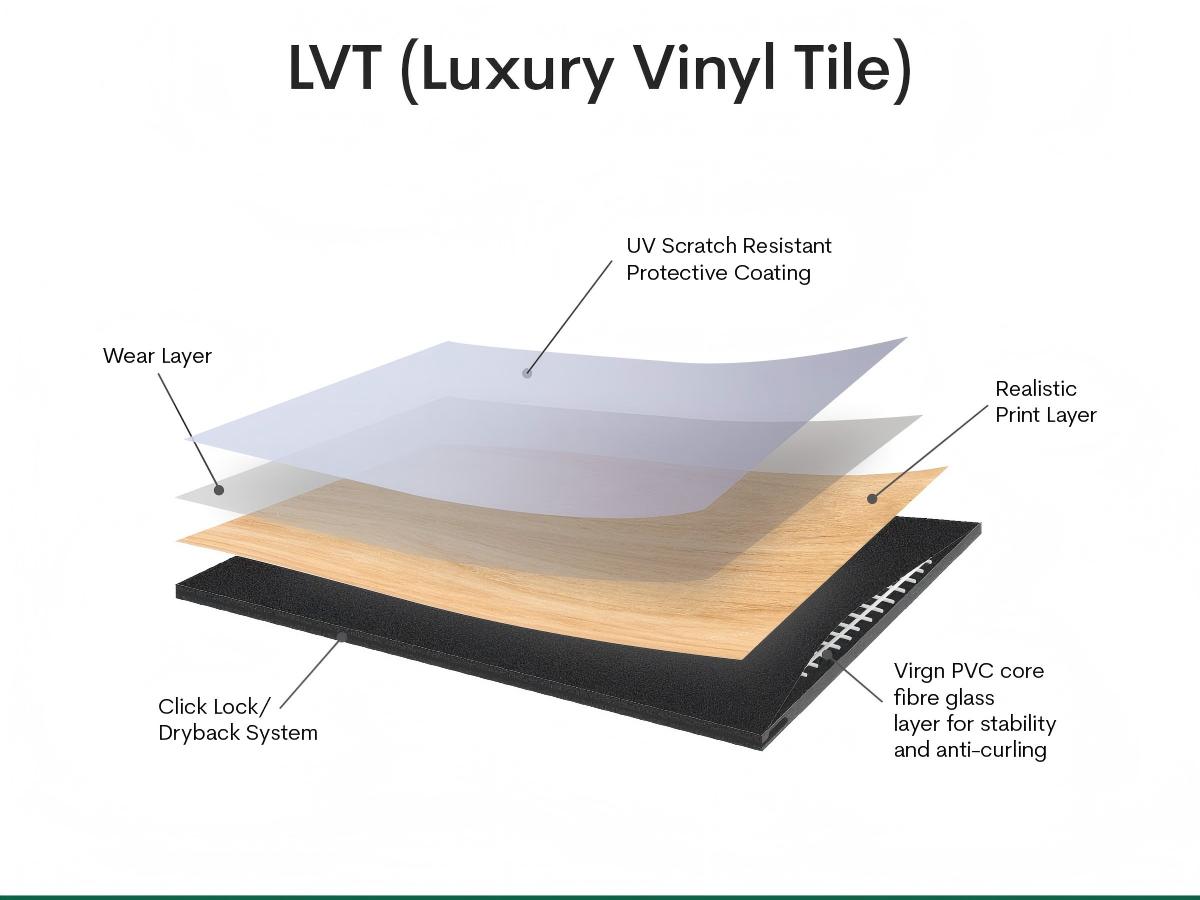
2. Multi-Layer Co-Extrusion in a Single Pass Modern lines co-extrude multiple layers (often 4–6) synchronously, achieving layer-thickness accuracy of roughly ±0.02 mm. Instead of laminating separately produced sheets, the base, reinforcement, decorative film, and wear layer are combined inline. Fewer steps, fewer handoffs, and fewer chances for misalignment translate directly into higher throughput and better dimensional stability.
3. Precision T-Die and Online Thickness Control A high-precision T-die combined with online gauging (often closed-loop feedback) keeps sheet thickness and flatness consistent in real time. The line self-corrects before defects accumulate, which is why modern installations report finished-product yield rates of 98% or higher — versus significant scrap on conventional lines.
4. Multi-Roll Calendering for Perfect Layer Bonding Multi-roller calender systems laminate the base layer, printed film, and wear layer under precisely controlled pressure and temperature. The result is flawless layer adhesion, a smooth surface, and fewer delamination rejects — all at continuous line speeds of roughly 6–10 m/min.
Learn more about SKY WIN's Double-layer LVT Flooring Extrusion Line for a closer look at co-extrusion and multi-layer production configurations.
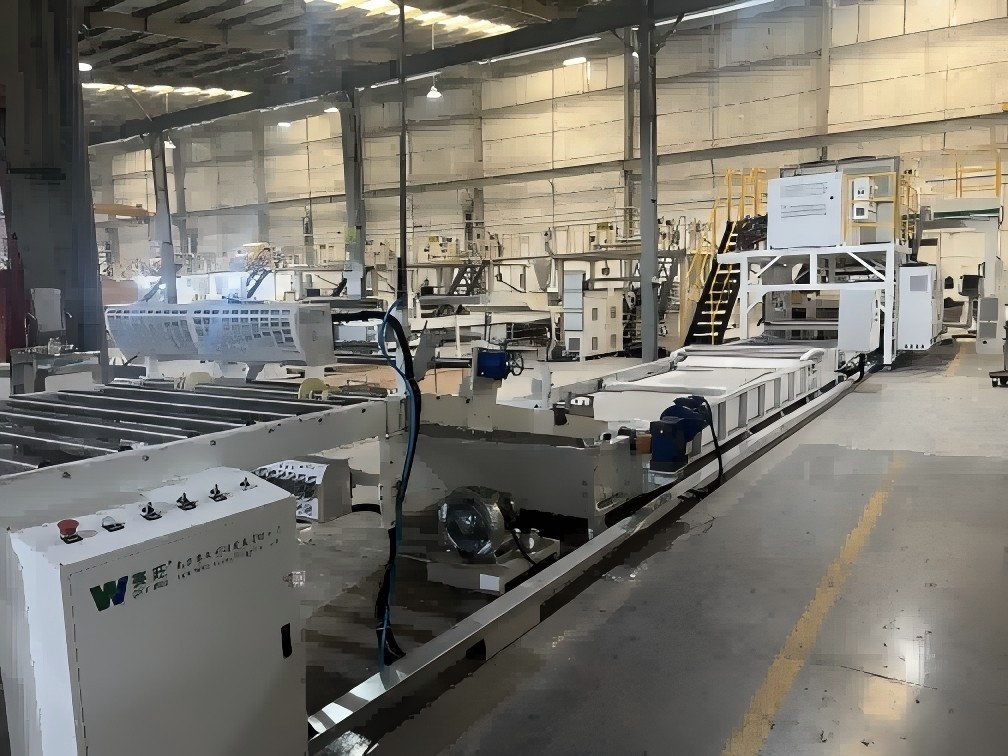
5. Automation, Robotics, and Digital Monitoring High-speed lines automate material feeding, in-line inspection, winding, trimming, cutting, and robotic stacking. Integrated sensors and IIoT dashboards track temperature, tension, and speed across the line, flagging anomalies before they become downtime events. Compared with comparable conventional equipment, operators report productivity gains of around 30%, with sharply reduced manual labor.
6. Energy and Material Efficiency Optimized screw designs and smart temperature control cut energy use per ton, while online gauging and precise feed reduce material waste. Lower scrap and lower energy together compress operating costs as output rises.
Depending on the product structure and production requirements, manufacturers can also review the PVC Flooring (SPC/LVT) Sheet Extrusion Line when comparing flooring production equipment.
Putting these together, a high-speed LVT extrusion line improves production efficiency in four measurable ways:
· Higher throughput — more square meters per hour, per shift, per line.
· Lower waste — fewer rejects and less edge trim, thanks to inline gauging and co-extrusion.
· Better consistency — every batch matches the last, protecting brand quality and reducing rework.
· Leaner labor — automation shrinks headcount per line and frees operators for higher-value tasks.
High-speed LVT extrusion lines are not just "faster versions" of older machines — they are a different production philosophy. By integrating twin-screw extrusion, single-pass multi-layer co-extrusion, precision calendering, and intelligent process control, they convert the inherent complexity of LVT into an efficiency advantage. For flooring manufacturers competing on cost and quality, upgrading the extrusion line is one of the highest-leverage investments available.
Want to learn more about configuring a high-speed LVT line for your product mix and output target? Get in touch with our engineering team.
Contact SKY WIN's engineering team to discuss your production requirements.
A high-speed LVT flooring extrusion line is an integrated production system that processes PVC compounds into flooring sheets. It can combine extrusion, T-die forming, calendering, lamination, cooling, trimming, and cutting in a continuous workflow.
Twin-screw extrusion supports compound mixing, plasticization, and material conveying. When the screw design and processing conditions are properly matched to the formulation, the system can help maintain stable output and consistent sheet quality.
Calendering uses controlled rollers, pressure, and temperature to help produce a uniform sheet surface and bond flooring layers. Proper settings can reduce thickness variation and bonding defects.
Output depends on the extruder configuration, raw material formulation, sheet thickness and width, line speed, cooling capacity, downstream equipment, and the stability of the overall process. Actual capacity should be evaluated against the required product specifications.
Manufacturers should consider the LVT product structure, target output, sheet dimensions, material formulation, automation requirements, factory layout, energy use, and maintenance needs. Discussing these factors with an equipment supplier helps determine an appropriate line configuration.
No.18,Huixin Rd.,Yangtze River Dev.Zone,Nanjing 211505China



 IPv6 network supported.
leave a message
Scan to Wechat :

Scan to WhatsApp :