
leave a message
If you are interested in our products and want to know more details,please leave a message here,we will reply you as soon as we can.


Thickness consistency is one of the key quality indicators in SPC flooring production. When the flooring core sheet is too thick in some areas and too thin in others, manufacturers may face problems during lamination, cutting, profiling, and final product inspection. Even when the average thickness meets the specification, local variations can still affect finished flooring quality.
To improve thickness consistency in SPC flooring production, manufacturers need to control the entire process rather than adjust only one machine setting. Material formulation, feeding stability, extrusion pressure, calendering conditions, cooling, and haul-off speed can all influence the final sheet thickness.
For manufacturers evaluating a new SPC flooring extrusion line, these factors should be considered together because stable output depends on how the complete production system works as a unit.
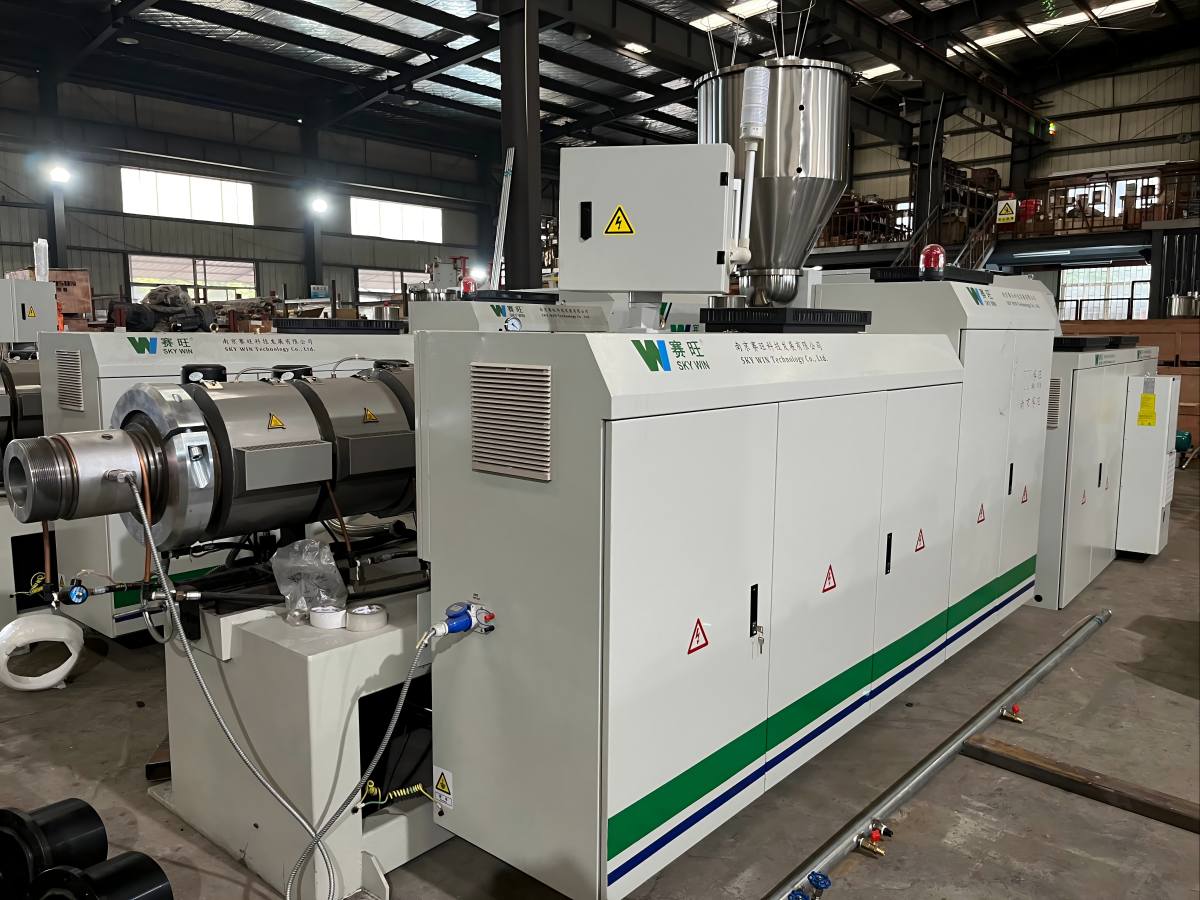
SPC flooring sheet production equipment used to process PVC and calcium carbonate composite materials.
Thickness variation usually results from several process conditions interacting with each other. Before changing machine settings, operators should identify whether the problem is related to material feeding, extrusion, the calendering section, cooling, or downstream pulling.
Common causes include:
A useful first step is to record where the variation occurs. If thickness changes over time at the same measuring point, investigate process stability. If the center is consistently thicker than the edges, inspect the calendering system and material distribution across the sheet width.
Stable sheet thickness starts before the compound enters the extruder. SPC flooring commonly uses PVC resin, calcium carbonate, stabilizers, and processing additives. Differences in batch composition, mixing quality, bulk density, or feeding rate can change the way the material melts and flows.
Manufacturers should use a controlled formulation and follow the same material preparation procedure for each production batch. Check weighing equipment, feeder calibration, mixing time, and material handling practices. If recycled material is used, its proportion and processing characteristics should also be controlled.
When a thickness problem appears after changing suppliers or switching material batches, compare the affected batch with a previously stable batch before making major machine adjustments. This helps prevent operators from compensating for a material issue by introducing unnecessary changes to the extrusion process.
It is also important to maintain a consistent feeding rate. Surges or interruptions in feeding can lead to output fluctuations, making it difficult for the downstream calendering system to maintain a stable sheet profile.
The extruder must plasticize the compound consistently and deliver a stable melt flow to the downstream equipment. If temperature distribution, screw operation, or material feeding changes significantly during production, the sheet may develop thickness fluctuations even when the calender roll gap remains unchanged.
Operators should monitor the following conditions:
Do not assume that increasing temperature or screw speed will automatically improve thickness consistency. Excessive changes can affect material viscosity, plasticization, and production stability. Adjust settings in a controlled manner and allow the process to stabilize before measuring the result.
For equipment selection, the extruder should be matched to the formulation, target sheet width, required thickness range, and planned output. SKY WIN's SPC/LVT/WPC flooring extrusion machines category provides a starting point for comparing equipment intended for different flooring production requirements.
Calendering is one of the most important stages for controlling the thickness of an SPC flooring base sheet. The roll gap influences sheet thickness, while roll alignment, temperature uniformity, and pressure distribution affect how evenly the material passes through the rolls.
If the sheet is consistently thicker in the middle and thinner at the edges, or the reverse, checking the calendering section should be a priority. Possible causes include uneven roll temperature, roll deflection under load, incorrect alignment, uneven material distribution, or a gap that is not set consistently across the working width.
To improve control:
Calender roll gap should not be treated as a direct substitute for final thickness measurement. The sheet may change dimension as it leaves the rolls and cools, so measurements should be taken at a defined point in the process and checked again after the sheet reaches a stable condition.
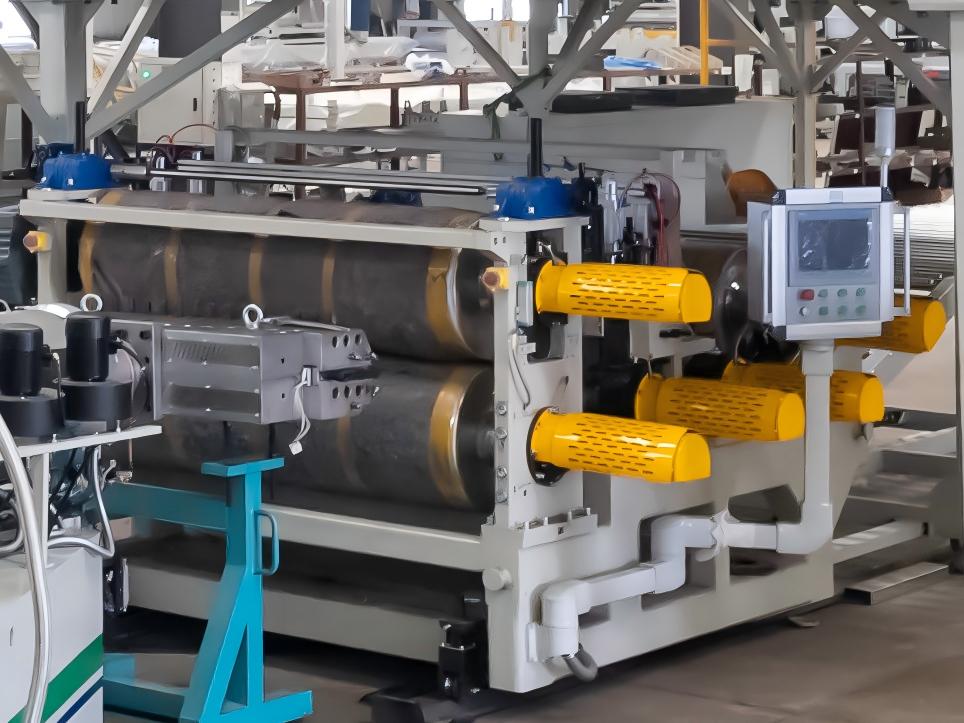
The calendering section plays an important role in controlling sheet thickness and material distribution.
The haul-off unit pulls the sheet through the downstream section. If pulling speed is not coordinated with extrusion output and calendering conditions, the sheet may be stretched or subjected to unstable tension.
When the sheet becomes thinner as the line speed increases, check whether the haul-off speed is rising faster than the extrusion output can support. If the sheet thickness fluctuates during speed changes, inspect the synchronization between the extruder, calender, haul-off unit, and cutting system.
Practical checks include:
Operators should establish a stable baseline before increasing output. After a speed change, allow the line to settle and measure the sheet again rather than assuming the previous settings will deliver the same thickness at the new production rate.
Cooling affects dimensional stability after the sheet passes through the calendering section. If cooling is uneven across the sheet width or through the material, the sheet may retain residual stress or change dimension as it cools.
Check whether cooling conditions are consistent across the working width. Inspect the cooling system, water flow where applicable, roll temperatures, and the condition of cooling components. The correct setup depends on the line design, material formulation, sheet thickness, and production speed.
It is important to distinguish between a thickness variation created during calendering and a dimensional change that develops during cooling. Measure the sheet at a consistent location immediately after forming and again after cooling. If the initial thickness profile is already uneven, investigate extrusion and calendering first. If the profile changes significantly after cooling, review cooling uniformity and residual stress.

An integrated extrusion line needs coordinated forming, cooling, and downstream handling to maintain stable sheet quality.
A single measurement cannot show whether an SPC sheet has a consistent thickness profile. Measurements should cover both the machine direction and the transverse direction so operators can identify whether the variation is continuous, localized, or related to changes in line speed.
A practical quality-control routine includes:
The target thickness and allowable tolerance should come from the customer's product specification. Do not use one universal tolerance for every SPC flooring product, because the required limits depend on the product design, nominal thickness, and downstream processing requirements.
SKY WIN's published SWDB5 series specifications list sheet thickness options from 1.5 to 7 mm and sheet widths from 970 to 1220 mm across the listed configurations. These are equipment specifications, not a guarantee of thickness tolerance. Actual consistency depends on the selected configuration, formulation, operating conditions, and quality-control procedure.
When thickness variation continues despite careful process adjustment, manufacturers should evaluate whether the production line is appropriately configured for the target product. Important considerations include extruder capacity, calender roll design, temperature control, cooling capacity, haul-off synchronization, and the control system connecting the individual sections.
For a new project, provide the equipment supplier with the target sheet thickness, working width, material formulation, planned output, and required tolerance. These details make it easier to assess whether the proposed line is suitable for the actual production requirements.
The PVC Flooring (SPC/LVT) Sheet Extrusion Line is one of SKY WIN's relevant equipment options for manufacturers producing SPC and LVT flooring sheets. Its published system configuration includes an extruder, five-roll laminator, laminating unit, oil-heated roll system, cooling support frame, cooling system, edge trimmer, haul-off unit, sheet cutter, and electrical control system.
Because thickness consistency depends on the complete process, the goal is not simply to select a higher-output extruder. The line must maintain a suitable balance between extrusion output, calendering, cooling, and sheet handling at the required production speed.
When SPC flooring sheet thickness falls outside the target range, use a structured troubleshooting sequence rather than changing multiple parameters at once.
This approach helps operators isolate the source of variation, reduce unnecessary adjustments, and establish a repeatable production process. For manufacturers, repeatability is just as important as achieving the target thickness in a single sample.
How can manufacturers improve thickness consistency in SPC flooring production?
Manufacturers should stabilize raw material feeding and extrusion output, control calender roll gap and temperature, synchronize haul-off speed, maintain uniform cooling, and measure thickness at consistent locations. The most effective adjustment depends on where the variation begins.
Why is SPC flooring sheet thicker in the center than at the edges?
A center-to-edge thickness difference may be caused by uneven material distribution, calender roll alignment or deflection, non-uniform roll temperature, or an inconsistent roll gap. Measure the sheet across its width and inspect the calendering section before changing unrelated settings.
Can extrusion temperature affect SPC flooring thickness?
Yes. Temperature influences material plasticization and melt flow. Unstable temperature conditions can contribute to output variation and uneven material distribution. Temperature adjustments should be based on the material formulation and equipment manufacturer's operating guidance.
Does haul-off speed affect sheet thickness?
Yes. If the haul-off pulls faster than the extrusion and calendering sections can supply material, the sheet may stretch and become thinner. Check speed synchronization and observe thickness during controlled speed changes.
How should SPC flooring sheet thickness be measured?
Use calibrated measuring equipment and measure multiple positions across the width and along the production direction. Keep sample locations and measurement timing consistent, and compare results with the product's specified nominal thickness and allowable tolerance.
What sheet thickness can a SKY WIN SPC flooring extrusion line produce?
SKY WIN's published SWDB5 series specifications list sheet thicknesses from 1.5 to 7 mm and widths from 970 to 1220 mm across the listed configurations. The appropriate model depends on the required product dimensions, output, formulation, and production conditions.
Will a higher-output extrusion line automatically improve thickness consistency?
No. Higher output does not automatically mean tighter thickness control. Stable results depend on the coordination of extrusion, calendering, cooling, haul-off, and process control, as well as suitable equipment sizing and operation.
What information should be provided when selecting an SPC flooring extrusion line?
Provide the target sheet thickness and tolerance, sheet width, material formulation, planned production output, and downstream processing requirements. This information helps the supplier evaluate a suitable line configuration.
No.18,Huixin Rd.,Yangtze River Dev.Zone,Nanjing 211505China



 IPv6 network supported.
leave a message
Scan to Wechat :

Scan to WhatsApp :